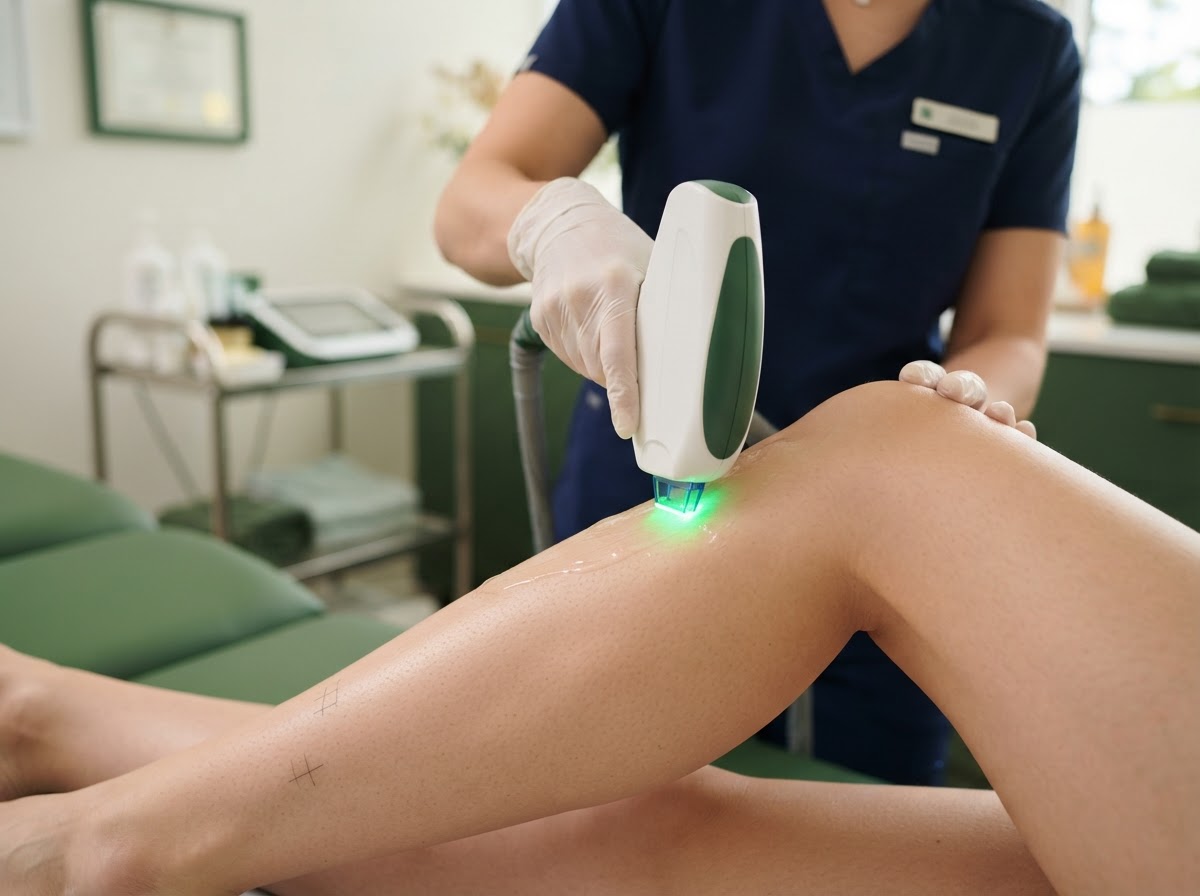
Laser Hair Removal at Lasers & Facials Med Spa in North Miami Beach, Florida. Soprano ICE laser hair reduction uses gradual, comfortable energy to target hair follicles across many skin tones, planned around your hair, skin, and treatment areas. All pricing is personalized after assessment, and every plan begins with a consultation — never a fixed menu price.
What it is
Soprano ICE by Alma is a diode laser platform designed for gradual hair reduction with built-in cooling for comfort. Treatment is planned across a series based on the hair growth cycle and your individual areas.
Laser and light treatments at Lasers & Facials Med Spa span hair reduction, photorejuvenation, fractional resurfacing, vascular concerns, and nail-fungus assessment. Each modality does something different, and the right one depends on your skin, your hair, the concern you want to address, and what you hope to achieve — which is why every plan starts with a consultation rather than a fixed menu price.
We keep device language accurate. Soprano ICE by Alma is used for gradual hair reduction. The Nordlys platform carries our Ellipse IPL and Frax 1550 fractional work. Nd:YAG 1064 is used for suitable vascular concerns. We do not claim to own every resurfacing system, we do not rename Frax 1550 as Fraxel, and we do not present a complete brand-device catalogue beyond what we actually use.
Light-based treatments are not interchangeable. IPL, Frax, and Nd:YAG each address different concerns: IPL for suitable pigment and redness, Frax 1550 for texture and suitable scar-related concerns, and Nd:YAG or appropriate IPL for suitable vascular concerns. Your provider recommends the right technology — or a combination — based on your assessment, not on a ranking of devices or on what happens to be popular.
Because the same concern can be approached several ways, a consultation is where the choice gets made honestly. A spot of pigmentation might suit IPL, or it might be better addressed alongside texture with Frax; a patch of redness might suit IPL or a vascular laser. Which one applies to you is a clinical decision, and pricing follows that decision rather than preceding it.
Lasers & Facials Med Spa sits at one address in North Miami Beach, and every laser and light appointment takes place there — never at a branch or a satellite room. Our phone number, (305) 705-3612, appears on every page so you can ask a quick question or request a consultation without searching for it, and our hours are Monday through Saturday, 10:00 AM to 7:00 PM.
Who it is suitable for
Adults in good general health with goals matched to this treatment, confirmed in consultation.
Common applications include unwanted hair across the face and body, sun damage and uneven pigmentation, suitable redness and visible vessels, texture irregularities and fine lines, suitable scar and stretch-mark concerns, and nail-fungus assessment. Suitability for any laser or light treatment depends on your skin tone, hair color, medical history, and current medications, all of which are reviewed in consultation before a plan is recommended.
For hair reduction, areas run from small zones like the upper lip, chin, and underarms through larger zones like the legs, back, and full body. Each area has its own page because the planning, comfort considerations, and session count differ by zone. We use professional language for intimate areas, and the bottom line and intergluteal area are described clinically rather than colloquially.
For pigmentation and redness, the concern itself guides the technology. IPL can be appropriate for age spots, sun spots, freckles, dark spots, and uneven pigmentation, as well as suitable redness and photorejuvenation concerns — but it is not appropriate for every tone or every type of pigmentation, and we do not promise that it is. Vascular concerns such as facial vessels, broken capillaries, diffuse redness, suitable leg veins, port-wine stains, hemangiomas, and cherry angiomas are assessed first; which modality is appropriate is a provider decision, and symptomatic vein disease is not replaced by cosmetic surface treatment.
For resurfacing, Frax 1550 delivers fractional non-ablative energy for texture irregularities, fine lines, and suitable scar-related concerns across the full face, partial face, neck, chest, and hands, with suitable scar and stretch-mark concerns assessed individually. We keep the Frax branding accurate and do not claim ownership of other resurfacing systems, and we do not promise that a single resurfacing platform is right for every texture concern.
For nail-fungus concerns, laser assessment is a starting point for a plan, not a guaranteed cure. Suitability, the condition of the nail, and whether a separate medical evaluation is appropriate are all discussed in consultation before any treatment is planned, because some nail changes reflect something that needs medical attention rather than a cosmetic procedure.
Adults in good general health with goals that match a laser or light modality are the typical starting point, and suitability is confirmed in consultation. We do not treat minors without the appropriate consent and assessment, and we do not treat a concern that needs medical evaluation as though it were a cosmetic procedure. Your provider confirms what is appropriate for you before recommending anything.
Skin tone is a real consideration, not a box to check. A wavelength that is safe and effective for one tone may be inappropriate for another, and we do not assume the same settings for every skin. Soprano ICE is designed for a range of tones, but whether it is right for you specifically — and how a series should be planned for your area — is confirmed in person, and we do not promise that every tone is a candidate for every device.
Hair color matters for hair reduction. Laser hair removal targets the pigment in the follicle, so hair with more pigment is typically more responsive than very light, gray, or red hair. We do not promise that every hair color responds the same way, and we explain what that means for your goals in the consultation rather than implying a uniform result. Some people are better served by a different approach, and we say so when that is the case.
Medical history is reviewed honestly. Pregnancy, certain medications, a history of keloid scarring, active skin infections, recent sunburn, and some chronic conditions all affect what is safe to plan. We ask about these in the consultation, and we adjust or defer a plan when the honest answer is that now is not the right time. We would rather postpone a session than treat skin that should not be treated.
People with cosmetic concerns that could reflect something medical — a changing pigmented lesion, a symptomatic vessel pattern, a nail change with features that need evaluation — are not simply booked for a treatment. Your provider assesses whether the concern is appropriate for aesthetic treatment or whether it should be evaluated medically first, and we say so plainly when a referral is the more appropriate next step.
People planning around an event are welcome and common, and we set realistic timelines. If you have a wedding, a trip, or a photoshoot in mind, the consultation is where we map what can sensibly be achieved before that date and what would be better left for after. We do not promise that a series fits into a week, and we do not compress a plan to a point that would compromise the result or your skin.
When it may not be appropriate
May not be appropriate for certain skin conditions, active infections, pregnancy, or specific medical histories — assessed by your provider.
Considerations include your skin tone and how a given wavelength interacts with it, recent sun exposure, active skin conditions, pregnancy, certain medications, and whether a concern is cosmetic or needs separate medical evaluation. Some medications and supplements affect healing or pigmentation; some skin conditions change what is safe to treat; and some concerns that look cosmetic can reflect something that needs medical attention first.
We describe hair work as reduction, not guaranteed permanent removal for everyone, and we do not promise that IPL treats every skin tone or every type of pigmentation. Visible vessels and redness that could reflect underlying vein disease are not replaced by cosmetic surface treatment — a provider assesses whether the concern is appropriate for aesthetic treatment or whether it should be evaluated medically first.
Recovery varies by treatment and individual. Some treatments leave little visible aftercare; others involve peeling, redness, or temporary darkening before improvement. Your provider explains what is likely for your treatment and skin before you commit, and aftercare guidance is individualized rather than a generic routine applied around every procedure.
Skin tone matters more in light-based treatments than in many other services. A wavelength that is safe and effective for one tone may be inappropriate for another, and a concern that responds well on one area of the face may need different planning on the neck or chest. We do not assume the same settings for everyone, and we do not promise that a single device is appropriate for every skin we see.
Some concerns are better referred than treated. A pigmented lesion with changing features, a vessel that is part of a symptomatic vein pattern, or a nail change with features that need dermatologic evaluation are examples where the honest next step may be a medical referral rather than a cosmetic appointment. We say so plainly when that is the case rather than treating something that should be evaluated first.
Methods and how it works
Your provider explains the plan, expected sensations, and aftercare during your consultation; recovery varies by individual and treatment area.
Methods vary by concern. Hair reduction is planned across a series based on the hair growth cycle, using gradual, comfortable energy with built-in cooling. IPL targets suitable pigment and redness with settings chosen after assessment. Frax 1550 delivers fractional non-ablative resurfacing for texture, fine lines, and suitable scar-related concerns. Vascular work may use Nd:YAG 1064 or appropriate IPL depending on what is being treated.
The device and settings are never assumed in advance — they are confirmed for you specifically. Two people with the same surface concern can need different settings because their skin tone, sensitivity, or history differ, and a treatment that works well for one area may be planned differently for another. We do not publish old formulation percentages or clinical outcome statistics as promises.
Where concerns overlap — tone and texture, or pigmentation and redness — a combined-planning approach can sequence technologies sensibly rather than performing everything at once. Your provider explains how the technologies differ, what each can and cannot do, and how a plan would be spaced. Session counts and spacing are personalized after assessment, never a fixed schedule applied to everyone.
Comfort is part of the method, not an afterthought. Soprano ICE's built-in cooling, the pacing of energy delivery, and the size of the handpiece all affect how a session feels, and we adjust them based on the area and your tolerance. IPL and Frax sessions are typically shorter than hair-reduction sessions; vascular treatment can be quick for a single vessel or more involved for diffuse redness. We set expectations for the session itself, not only for the series.
Combining technologies is a clinical decision, not a marketing bundle. The Nordlys Light & Bright approach, for example, sequences IPL and Frax for tone and texture together only when both are appropriate for your skin and goals — not as a default for everyone. Your provider explains why a combination would or would not suit you, and the plan reflects that decision rather than a preset package.
Laser and light treatments differ in what they target and how. A laser delivers a single, concentrated wavelength chosen for a specific target — the pigment in a hair follicle for hair reduction, the pigment in a spot for some pigmentation, water in tissue for resurfacing. Intense pulsed light (IPL), by contrast, delivers a broad band of light that is filtered for the concern being treated, which is why IPL can address both pigment and redness in a single pass over suitable skin. Understanding this difference matters because it explains why the same concern can be approached more than one way and why the right choice depends on your skin rather than on which device is newest.
The hair growth cycle is the reason a series is typical for hair reduction rather than a single session. Hair passes through an active growth phase, a transitional phase, and a resting phase, and a follicle is most responsive to laser energy during the active phase. Because follicles on a given area are not all in the same phase at the same time, a series spaced several weeks apart catches different cohorts of follicles as they enter the active phase. The spacing depends on the area and how quickly the hair cycles there, which is part of why a plan is personalized rather than fixed for everyone.
Fractional resurfacing with Frax 1550 works by creating microscopic zones of treatment across the skin while leaving untreated skin between them. That fractionated pattern is what allows the skin to recover more comfortably than a fully ablative treatment, because the untreated tissue supports healing. The trade-off is that fractional treatments are usually planned as a series for a more complete result, and the number of sessions depends on the concern, the area, and how your skin responds. We do not promise that a single session produces a final result, and we do not claim that Frax replaces a surgical procedure.
Vascular treatment is more nuanced than it looks. A single broken capillary on the side of the nose may resolve with a quick targeted pass, while diffuse redness across the cheeks may need a planned series and a different approach. More importantly, some vessels that look cosmetic are part of a pattern that reflects underlying vein function, and treating the surface does not address the underlying cause. Your provider assesses whether a concern is appropriate for aesthetic treatment or whether it should be evaluated medically first, and we say so plainly when that is the case rather than treating something that should be diagnosed first.
IPL's role is specific, not universal. It can be a good fit for sun spots, age spots, freckles, and the kind of redness that comes from visible surface vessels on suitable skin, and it is often planned as a series for a gradual, cumulative brightening. It is not a fit for every type of pigmentation — some pigmented lesions need a different evaluation, and some need a different technology — and it is not appropriate for every skin tone. We do not promise that IPL treats every tone or every spot, and we explain why in the consultation rather than promising it and disappointing you later.
Combined planning, such as the Nordlys Light & Bright approach that sequences IPL and Frax, is not a default package. It is a plan that makes sense when both tone and texture are concerns for the same skin and the same timeline, and when the two technologies can be spaced without overloading the skin. Your provider explains whether a combination would suit you or whether one technology alone would do the work more sensibly, and the plan reflects that decision rather than a preset bundle that assumes everyone needs both.
Nail-fungus assessment with laser is a planning step, not a guaranteed outcome. The condition of the nail, how long the concern has been present, and whether there are features that need dermatologic evaluation all affect what a realistic plan looks like. Some cases are appropriate for a laser-based plan; others are better served by medical treatment or a combination. We keep the assessment honest and do not promise that laser resolves every case, because the honest answer is that results vary and some nails respond better than others.
Treatment type
Laser & Light
Potential goals
Soprano ICE by Alma — consultation-led hair reduction.
Recovery
Varies by individual and treatment area
Preparation and what to expect
Before treatment, your provider reviews the area, explains expected sensations, and confirms suitability. You may be asked to avoid sun exposure and self-tanning products for a period beforehand, to pause certain skincare actives, and — for hair reduction — to avoid plucking or waxing the treatment area ahead of a session, since the follicle needs to be present for the laser to target it.
What to expect during treatment — including comfort measures and how long a session may take — is discussed in person because it varies by area, device, and individual. Some treatments are quick; others cover larger areas or require more passes. Your provider sets realistic expectations for the session itself, not just the series.
On the day of treatment, you may be asked to arrive with clean skin, to remove certain products, or to adjust your routine for a short period after. These instructions are specific to your treatment and skin, and we do not prescribe the same preparation around every procedure. If anything is unclear, your provider answers it before we begin.
For hair reduction specifically, the follicle needs to be present for the energy to target it, which is why plucking and waxing are paused ahead of a series and shaving is typically discussed in consultation. For IPL and Frax, avoiding sun exposure and certain actives for a period beforehand helps reduce the chance of unwanted pigmentation changes, and the exact guidance depends on your skin and the time of year.
Plan a little buffer after light-based treatments rather than scheduling them the day before a major event. Hair-reduction sessions usually involve little visible downtime, but IPL and Frax can involve temporary redness, mild swelling, or, with some vascular work, small scabs that take a few days to resolve. If you have a specific date in mind, tell your provider during the consultation so the timeline can be set with enough margin.
Request your consultation
Share a few details through our form or call (305) 705-3612, and our team reaches out to confirm availability — we do not display a fake confirmed appointment.
Discuss goals and suitability
Your provider assesses your skin, history, and what you hope to achieve before recommending anything, and explains honest limitations.
Receive a personalized plan and quote
Pricing is tailored to you and your areas — never a fixed menu price or a one-size package, because goals and responses vary by person.
Treatment and follow-up guidance
Care and aftercare are explained in advance, with follow-up as needed; we do not promise same-day treatment or a fixed schedule for everyone.
Aftercare and ongoing support
Aftercare is individualized. Your provider explains what to do — and what to avoid — after your specific treatment, including skincare, sun protection, and when to resume actives or activity. We do not prescribe the same acid or retinoid routine around every procedure; home-care guidance defers to your clinician's instructions for your skin and your treatment, because what suits one person can irritate another.
Follow-up depends on the service and your goals. Some treatments are planned across a series, while others are occasional maintenance. Your provider sets the cadence with you and is available to answer questions between visits, and the plan can evolve as your skin or goals change over time.
We keep aftercare honest rather than generic. If a treatment involves downtime, we tell you; if it requires sun avoidance, we tell you; if it interacts with medications or actives, we tell you. The goal is that you leave with a clear understanding of how to care for your result, not with a one-size instruction sheet that does not match your skin or your treatment.
Serving North Miami Beach
Lasers & Facials Med Spa is located at 3749 NE 163rd St, North Miami Beach, FL 33160 — one physical location, not a franchise and not a chain of branches. Visitors travel to us from surrounding communities such as Aventura, Sunny Isles Beach, Bal Harbour, North Miami, Bay Harbor Islands, and Eastern Shores, all coming to the same address for their appointments.
Serving an area is different from having an office in it. We do not offer house calls or perform treatments in those communities; every appointment takes place at our North Miami Beach location. Current hours are Monday through Saturday, 10:00 AM to 7:00 PM, and we confirm hours before launch rather than guessing Sunday availability.
Finding the spa is straightforward from anywhere in the area. We provide directions and a map on our Visit Us page, and our phone number — (305) 705-3612 — is available on every page for quick questions or to request a consultation. We do not list branches we do not have, and we do not imply services performed anywhere other than our confirmed North Miami Beach address.
Reasons to choose Lasers & Facials Med Spa
Individualized plans
Every recommendation starts with a consultation and your goals — never a fixed menu price, and never a one-size package applied to everyone.
A broad, documented menu
Lasers, injectables, radiofrequency, facials, peels, body treatments, and wellness under one roof, each with its own page and its own planning.
Clear explanations and honest limits
We explain treatment differences, suitability, and what a treatment cannot do — we do not promise painless care, zero downtime, or guaranteed results.
One accessible location
A single North Miami Beach address at 3749 NE 163rd St, with phone and directions available on every page and bilingual support in English and Spanish.
Results, goals, and limitations
The potential benefits of laser and light treatments depend on the concern. Hair reduction can reduce the need for shaving and waxing over a series; IPL can brighten suitable pigmentation and redness for a more even-looking tone; Frax 1550 can smooth the appearance of texture, fine lines, and suitable scars; vascular treatment can reduce the appearance of suitable visible vessels. None of these are guaranteed for everyone, and results vary by individual.
Balanced against benefits are honest limitations. We describe hair work as reduction, not guaranteed permanent removal. IPL is not appropriate for every skin tone or every type of pigmentation. Resurfacing does not replicate surgical results. Vascular surface treatment does not replace evaluation of symptomatic vein disease. Recovery and the number of sessions vary, and we do not promise painless treatment or zero downtime. We state these limits plainly so you can plan with realistic expectations.
A benefit worth naming plainly is clarity. A consultation with light-based devices is often where a concern gets correctly identified — a spot that looked like pigmentation may be a vessel; a rough patch that looked like acne scarring may be better addressed with a peel. The benefit of the assessment is not only a treatment plan but a correct understanding of what you are treating, which changes what a realistic result looks like.
For hair reduction specifically, the benefit builds across a series. Early sessions often reduce the density and growth rate of hair in the treated area; later sessions catch follicles that were in a different phase of the growth cycle at the time of an earlier visit. The cumulative effect is a reduction in the routine of shaving or waxing, and we discuss what that realistically looks like for your area rather than promising an end to all hair after one visit.
Results depend on the treatment, your skin or body, and how you respond — never on a guarantee we make in advance. Some changes appear quickly; others build over a series or over weeks as collagen, skin, or the treated area responds. We discuss what a realistic result looks like for you specifically during your consultation, and we do not promise universal outcomes or a specific timeline that applies to everyone.
A result is usually part of a plan rather than a single visit. Hair reduction is built across a series; tightening and texture are assessed over weeks; fillers and biostimulators have their own onset and longevity. We explain the expected arc of your result before you commit, and follow-up is scheduled around your response rather than on a fixed schedule applied to everyone.
We separate honest expectations from marketing. We do not promise painless treatment, zero downtime, surgical-equivalent results, or guaranteed permanent removal. We do explain what a treatment can realistically do, what it cannot do, and what would be required to maintain the result. If a goal is better served by a different treatment or by no treatment, we say so rather than fitting you to the nearest available service.
Safety and honest limits
Safety comes from assessment, not from a one-size protocol. Your provider reviews your history, medications, skin or body condition, and goals before recommending a treatment, and confirms that the chosen approach is appropriate for you. Some treatments are not suitable during pregnancy, with certain medications, over active inflammation, or for particular skin types — and we tell you rather than proceeding.
We keep claims honest. We do not invent credentials, years of experience, awards, or certifications; we do not guarantee outcomes; and we do not describe treatments as risk-free or universally safe. If a treatment involves downtime, possible effects, or aftercare, we explain it in advance. The goal is that you make decisions with accurate information, not with promises that the treatment cannot keep.
Comparing this treatment with your other options
Comparing your options is part of what a consultation is for. Most concerns can be approached more than one way, and the right choice usually depends on your skin or body, the timeline you are comfortable with, and what you hope to see — not on which device is newest or which treatment is most advertised. A filler and a biostimulator can both add volume, but they work on different timelines and suit different goals. A peel and a resurfacing laser can both improve texture, but they differ in depth, recovery, and what they are appropriate for. A consultation is where those differences get explained for your specific case rather than as a general comparison.
It also helps to know what a treatment does not do. Laser hair reduction does not end shaving forever for everyone in one visit. A wrinkle relaxer softens movement-related lines but does not stop them from forming elsewhere. A tightening treatment can improve the appearance of laxity without replicating a surgical lift. Understanding the boundary between what a treatment can and cannot do is part of planning realistically, and we would rather state that boundary plainly than let you arrive with an expectation the treatment cannot meet.
Sometimes the honest recommendation is a different treatment than the one you came in asking about, or a combination rather than a single service. We are not invested in selling one device over another; we are invested in your plan making sense. If a less intensive option fits your goal, we say so. If two treatments are stronger sequenced than rushed together, we space them. If a concern is better evaluated medically first, we tell you before proceeding. That is the difference between a menu of services and an individualized plan.
You are welcome to come in with questions even if you are not sure you want to book. Understanding the options, the likely recovery, and the personalized pricing is a reasonable use of a consultation — you do not have to commit to a treatment to understand what it would involve. We treat that conversation as the starting point of care, not as a sales step, and we keep it honest even when the honest answer is that a treatment is not the right fit right now.
Comparing laser hair removal with waxing, threading, and shaving is a common part of a consultation. Shaving cuts the hair at the surface, so it returns quickly; waxing and threading remove the hair from the root, so the result lasts longer but the follicle remains and the hair returns. Laser hair reduction targets the follicle itself over a series, which is why the goal is a reduction in the routine of removing hair rather than a permanent end to all growth after one visit. Your provider explains what that realistically looks like for your area and your hair, rather than promising that the hair never returns.
Comparing IPL with Frax often comes down to tone versus texture. IPL is typically chosen when the concern is pigment or redness and the texture is otherwise satisfactory; Frax is chosen when texture, fine lines, or suitable scar-related concerns are the priority. When both are concerns, a combined-planning approach can sequence the two, but it is not automatic — your provider confirms whether your skin tolerates both in a reasonable timeline before recommending it.
Comparing a vascular laser with IPL for redness depends on the pattern. A discrete vessel may be best treated with a targeted vascular laser such as Nd:YAG 1064; diffuse redness may be better served by IPL. Some people have both patterns and benefit from a sequenced plan; others have a concern that is better evaluated medically first. The comparison is a clinical one, not a menu choice, and we keep it honest even when the honest answer is that a different evaluation would serve you better.
Comparing resurfacing with a peel is a frequent question. Frax 1550 uses light-based fractional energy for texture and suitable scar-related concerns; a chemical peel uses a formulated solution for pigment, acne, or radiance. The two can overlap in what they address, but they differ in depth, recovery, and what they are appropriate for, and the right choice depends on your skin and goals rather than on which is more familiar. We link to the chemical peels category where relevant and let the consultation decide which fits you.
Comparing laser hair reduction with electrolysis comes up for people deciding between a series of laser sessions and a permanent hair-by-hair approach. Laser reduction treats many follicles in a single pass and is planned across a series; electrolysis treats one follicle at a time and is the method some people choose for certain areas or hair colors. We do not offer electrolysis, and we are honest about that rather than implying laser does what electrolysis does, because the two are different tools with different goals.
Comparing devices across clinics is natural, but it is not the comparison that decides your result. Two clinics using the same platform can produce different outcomes because of settings, technique, and the plan around the device. We keep device language accurate — Soprano ICE for hair reduction, Nordlys IPL and Frax 1550 for tone and texture, Nd:YAG 1064 for suitable vascular concerns — and we focus the consultation on whether the plan makes sense for you rather than on which device wins a comparison it cannot fairly be part of.
Planning treatment around your schedule and budget
Planning your treatment around your schedule matters as much as planning it around your skin. Some treatments fit easily around work and social plans with little visible aftercare; others involve a few days of peeling, redness, or settling before you feel fully recovered. If you are planning around a wedding, a trip, or a specific date, tell your provider during the consultation so the timeline can be set realistically — including enough margin before the event for any settling to pass.
Series treatments deserve their own planning conversation. Laser hair removal, radiofrequency, certain peels, and microneedling with PRP are usually planned across multiple sessions spaced over weeks or months, and the cadence depends on the area, the treatment, and how you respond. We do not compress a series into a single visit to make a schedule fit, and we do not promise a fixed number of sessions before assessing you — the plan is confirmed after your first visit and adjusted as your response becomes clear.
Budget is part of planning too, and personalized pricing means the quote follows your plan rather than preceding it. Because areas, goals, and session counts vary by person, a fixed price list would not reflect what you actually need. After your consultation, you receive a quote for the plan recommended for you — not a guess and not a package price that assumes everyone is the same. If you want to start with a smaller area or a single session and build from there, that is a reasonable way to begin, and we help you sequence it.
Follow-up is built into the plan rather than treated as an extra. Your provider sets the cadence for review, checks how your skin or body is responding, and adjusts the plan if needed. If something is not working as expected, we would rather hear about it at a follow-up than have you assume the treatment failed — sometimes a small adjustment to settings, spacing, or aftercare makes the difference. Ongoing support is part of how we deliver care, not a separate service.
Series treatments are the norm for most laser and light goals, and the cadence is part of the plan rather than a fixed schedule. Hair reduction is typically spaced several weeks apart because of the hair growth cycle; IPL for pigment may be spaced a few weeks apart; Frax resurfacing is often spaced to allow the skin to recover between sessions. The spacing for you depends on the area, the concern, and how your skin responds, and it is confirmed after your first visit rather than set in advance for everyone.
Personalized pricing follows the plan, not the other way around. Because the device, the area, the number of sessions, and the spacing all vary by person, a fixed price list would not reflect what you actually need. After your consultation, you receive a quote for the plan recommended for you — not a guess and not a package price that assumes everyone is the same. If you want to start with a smaller area or a single session and build from there, that is a reasonable way to begin, and we help you sequence it.
Budget is part of planning, and we treat it as such rather than as an afterthought. If a full series is more than you want to commit to at once, we can discuss starting with one area or one phase and adding sessions over time. The plan is built around your goals and your budget together, and we do not push a larger package than you need. The honest conversation about cost happens in the consultation, and the quote reflects what is recommended for you specifically.
Scheduling around life is part of the plan. South Florida sun is a real consideration for light-based treatments, and avoiding intense sun exposure around a session is part of the guidance for many laser and IPL plans. If you have a trip, an event, or a season in mind, tell your provider so the timeline can be set with enough margin for any settling. We would rather space a plan sensibly than compress it to fit a date that does not leave room for recovery.
Follow-up is built in rather than treated as extra. Your provider checks how your skin or area is responding, adjusts settings or spacing if needed, and answers questions between visits. If something is not going as expected, we would rather hear about it at a follow-up than have you assume the treatment failed — sometimes a small adjustment to settings, spacing, or aftercare makes the difference, and the plan can evolve as your response becomes clear.
Combining a laser or light plan with other treatments is a planning conversation, not a rule. Some treatments can be sequenced sensibly in the same period; others need separation because they affect the same skin. Your provider looks at the full picture — the facial, the peel, the filler, the microneedling — and helps you sequence everything so the treatments support each other rather than competing for the same skin in the same week.
Frequently asked questions
Does laser hair removal work on all skin tones?
Soprano ICE is designed for a range of skin tones, but suitability is confirmed in consultation based on your skin, hair, and history — it is not guaranteed for everyone. We describe it as reduction, not guaranteed permanent removal.
How many sessions will I need?
Session planning is personalized after assessment. A series is typical for hair reduction because hair grows in cycles, and the exact count depends on the area and your goals. We do not publish a fixed session count that applies to everyone.
Can IPL treat my pigmentation?
Not every tone or type of pigmentation is appropriate for IPL. Your provider assesses whether IPL is suitable for you or whether another approach — such as Frax for texture or a peel — better fits your concern and skin.
Is the hair removal permanent?
We describe it as reduction, not guaranteed permanent removal for everyone. Results vary by individual and area, and a series is typical because hair grows in cycles.
Will there be downtime?
Downtime varies by treatment and individual. Some treatments involve little visible aftercare; others involve temporary redness, peeling, or darkening before improvement. Your provider explains what is likely for your treatment and skin before any plan.
What's the difference between IPL and Frax?
IPL targets suitable pigment and redness for a brighter, more even-looking tone. Frax 1550 targets texture, fine lines, and suitable scar-related concerns. Some goals suit one, some suit the other, and some suit a combined-planning approach — your provider decides based on your assessment, not on a ranking of devices.
Do you treat all areas of the body for hair reduction?
Hair-reduction areas run from small zones like the upper lip and underarms through larger zones like the legs, back, and full body, each with its own page. We use professional language for intimate areas, and which areas apply to you is confirmed in consultation.
Does it work on all skin tones?
Soprano ICE is designed for a range of skin tones; suitability is confirmed in consultation.
How many sessions will I need?
Session planning is personalized after assessment; a series is typical because hair grows in cycles.
Is the hair removal permanent?
We describe it as reduction, not guaranteed permanent removal for everyone; results vary by individual.
Request Your Consultation
Share a few details and our team will reach out to confirm availability and personalize your plan.
Related services
Nordlys IPL Photorejuvenation
Ellipse IPL for suitable pigmentation, sun damage, and redness.
Learn moreFrax 1550 Resurfacing
Nordlys Frax 1550 fractional non-ablative resurfacing.
Learn moreView All Treatments
Advanced laser and light treatments for hair reduction, pigmentation, redness, texture, and vascular concerns — each planned around your skin and goals after a consultation.
View All Treatments